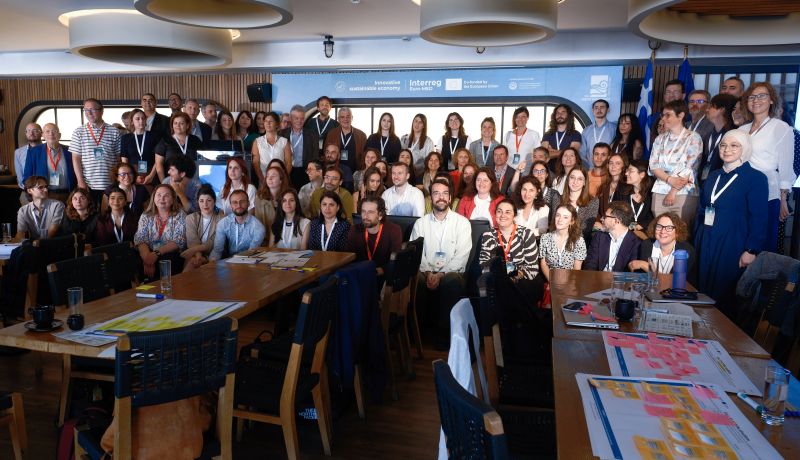
This spring has reaffirmed a spirit of cooperation, strengthening synergies and expanding opportunities for cross-fertilisation with the Governance and Thematic projects of Innovative Sustainable Economy Mission within the Interreg Euro-MED programme.
Here we previously shared some of the cross-fertilisation opportunities we took part in. Today, instead, we would like to dedicate some space to the week spent in Athens participating in the Circle the Med Forum and the MED Innovation Summit.
GREENSMARTMED in Athens: cooperation and regenerative innovation shaping the Mediterranean transition
Athens became a meeting point for Mediterranean cooperation and sustainable innovation during the 9th Circle the Med Forum and the MED Innovation Summit, organised under the framework of “A New Pact for a Sustainable Mediterranean Future” by the Innovative Sustainable Economy (ISE) Mission Interreg Euro-MED Programme.
Over three intense days, policymakers, researchers, businesses, innovators and civil society organisations gathered to discuss how the Mediterranean region can accelerate its transition towards a greener, more resilient and circular future. Through thematic panels, workshops, networking sessions and collaborative activities, the events created a dynamic space for exchanging ideas and strengthening partnerships across borders.
Among the projects actively contributing to the debate was GREENSMARTMED, which shared experiences and methodologies related to sustainable innovation, circular economy and territorial cooperation.
Regenerative economies and the challenge of sustainable growth
One of the key part of the MED Innovation Summit was the panel “Economies of Regeneration: Redesigning Growth for a Sustainable Future”, dedicated to exploring how regenerative and low-carbon models can reshape regional economies and industrial value chains.
During the discussion, Carlo Mondani from AFIL, partner of the GREENSMARTMED project, addressed the opportunities and challenges linked to the green and digital transition across Mediterranean ecosystems. A key message emerging from the panel was the urgent need to create a common language among businesses, research organisations, public authorities and civil society in order to make sustainability strategies more concrete and effective. 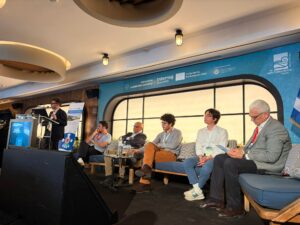
To address the issue the conversation the importance value of the Quadruple Helix approach was also highlighted. An approach oriented to connect institutions, companies, research actors and citizens through both top-down and bottom-up processes. According to the speakers, this collaborative model is essential to transform innovation into real territorial impact, giving voice to their real drivers.
Particular attention was given to emerging European sustainability frameworks such as the Digital Product Passport and Ecodesign Regulations, as well as the growing role of digital technologies, sensors and accessible data in supporting sustainable production systems.
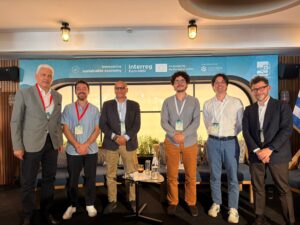 At the same time, the panel acknowledged that many companies — especially SMEs and startups — still struggle with regulatory complexity, transition costs and limited access to data and innovation resources. Participants repeatedly stressed the importance of coherent policies, stronger local governance and a Just Transition capable of including more vulnerable communities and territories. Placing growing emphasis on collective commitment and dialogue across different levels of governance as the only real levers for generating meaningful transformation.
Beyond technological innovation, the session ultimately reinforced a broader idea: regenerative growth requires long-term vision, shared governance and stronger cooperation across the Mediterranean.
Mentoring, twinning: collaboration across the two shores of the Mediterranean
Another significant moment for GREENSMARTMED was the session dedicated to the Mentoring & Twinning Programme promoted by the ISE Mission and coordinated by Community4Innovation.
The Programme supports knowledge transfer and collaboration between organisations operating in different territorial and socio-economic contexts of the two shores of the Mediterranean through exchanges between solution givers and takers.
Within this framework, GREENSMARTMED is collaborating with Birzeit University in Palestine. During the session, Olga Batran representing the University shared the difficulties faced by Palestinian institutions and businesses in advancing the green transition, including limited access to international innovation ecosystems, financial constraints and reduced opportunities for training and technology transfer.
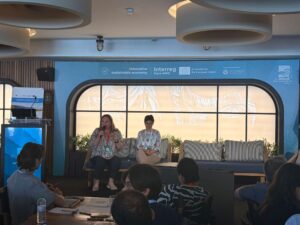 Her intervention highlighted how participation in European cooperation initiatives can represent a crucial opportunity for organisations working in fragile contexts, offering access to expertise, networks and transferable solutions.
Prof. Fabiana Pirola from the University of Bergamo, Lead Partner of the project, presented the activities developed to support the Palestinian partner, from methodology sharing and pilot testing to the adaptation of tools to local needs and the translation of materials into Arabic.
Beyond the technical aspects, one of the strongest messages emerging from the discussion concerned the human dimension of cooperation. Mentoring and twinning were described not only as project activities, but as a bridge capable of building trust, creating long-term relationships and opening new opportunities between territories and organisations.
Birzeit University also expressed gratitude for the continuous involvement in project activities despite the difficult local context, which often limited the possibility of participating physically in international events.
The session demonstrated how Euro-Mediterranean cooperation can generate meaningful impact even in highly complex environments, transforming collaboration into a concrete instrument for inclusion, empowerment and international openness.
Strengthening the ISE Community of Practice
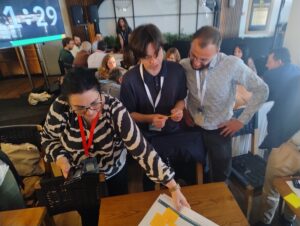 The final day in Athens concluded with the 5th meeting of the ISE Community of Practice, where partners continued the work of the thematic groups dedicated to sustainable innovation, circular economy and green transition strategies across the Mediterranean.
During the working sessions, participants were invited to validate the solutions identified during previous meetings so that they can be further integrated into the upcoming White Papers. In a second phase, based on the main target stakeholders identified by the projects, participants worked on prioritising the engagement activities considered most effective for amplifying the impact and dissemination of each project’s results.
The discussions once again highlighted the importance of collaborative methodologies and shared governance in supporting long-term sustainability transitions across Mediterranean territories.