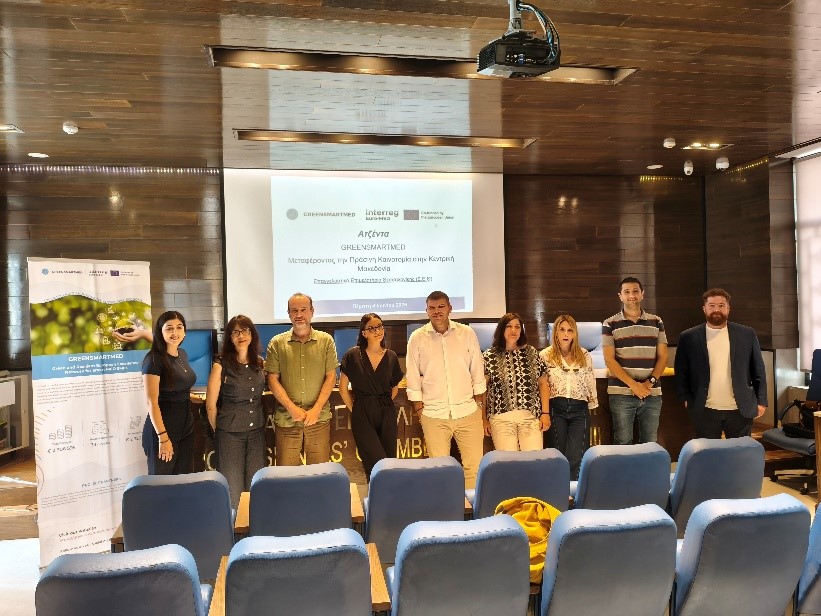
The GREENSMARTMED transfer workshop Transferring Green Innovation to Central Macedonia was successfully held on June 4, 2026, at the Professionals’ Chamber of Thessaloniki. The event brought together key regional stakeholders, business support organizations, and industry experts to foster knowledge exchange and collaboration. Its main objective was to present the GREENSMARTMED Methodology and Toolkit and support their transfer and adoption within the Central Macedonia region.
Transferring the GREENSMARTMED Toolkit to the Local Ecosystem
The event kicked off with welcomes from the Centre for Research and Technology Hellas and the Chamber of Professionals Thessaloniki. Representatives from the Regional Development Fund of Central Macedonia and ANATOLIKI S.A. also delivered opening remarks. Agapi Teftiki and Dimitris Chomatidis (CERTH) walked attendees through the project’s journey, methodology, and key results.
A special highlight of the session was an online presentation by Sarah Levecque from the Economic Council of East Flanders (ECEF), who shared an inspiring success story of the GREENSMARTMED Methodology’s adoption.
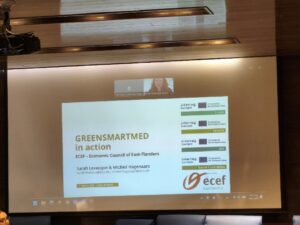 Notably, ECEF was not originally a partner in the GREENSMARTMED project, making its experience a strong testament to the value and transferability of the framework. The organization was first introduced to the Methodology through a presentation delivered during a DESICE project meeting in Estonia. Recognizing its potential, ECEF decided to incorporate the GREENSMARTMED Methodology into its new policy framework.
Joining the workshop virtually, Sarah provided first-hand insights into ECEF’s journey, explaining why the organization initially decided to explore the GREENSMARTMED Methodology, how it successfully integrated the approach with an existing tool developed by a local university in Ghent, the current stage of implementation, and the expected benefits for the regional ecosystem once the process is fully completed.
Circular Economy in Practice: Real-World Examples from Central Macedonia
A core focus of the event was showcasing how green practices can be realistically integrated into local business models.
Mr. Christoforos Aivazidis, President of the Public Relations Committee of the Chamber of Professionals Thessaloniki, emphasized that green initiatives must be clearly linked to direct financial benefits to be prioritized, noting that the Chamber heavily focusing on AI education to save time and resources for its members.
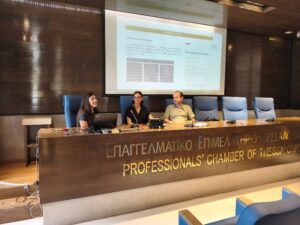 Mr. Bakouros, Scientific Associate at the Regional Development Fund of Central Macedonia, presented inspiring, tangible examples of circular economy models already running in the region by SMEs, such as the utilization of livestock waste for biogas and energy production, recycling and upcycling of by-products
Mrs. Eleni Iordanidou, EU Projects Manager at ANATOLIKI S.A., introduced additional tools supporting SMEs through EU projects, including those focusing on circular design, as well as advisory tools that evaluate SMEs level and directly link them to consulting support
Strategic Insights: Overcoming Obstacles and Ensuring Sustainability
During the interactive panel discussion, the focus shifted toward the practical adoption of the GREENSMARTMED Methodology and how the regional ecosystem received its proposed steps. The key takeaways were the following:
Audience Reception and the “Value Proposition”
The participants and local stakeholders expressed strong interest in the Toolkit, recognizing it as a structured pathway for green innovation. However, they raised critical points regarding the daily reality of local SMEs. With a high percentage of Greek businesses operating as micro- and small enterprises, the consensus was that for the methodology to be widely adopted, its steps must not be perceived as an added administrative or financial burden. The audience emphasized that the green transition must be explicitly framed and communicated as a tangible economic opportunity—demonstrating cost savings and efficiency—rather than just a compliance or environmental model
Integrating the Methodology into Existing Policies
A key topic of debate was how the steps of the GREENSMARTMED Methodology can be seamlessly woven into existing regional and professional support structures. Rather than creating new, isolated processes, speakers suggested that business support organizations (like chambers) and regional authorities can embed these tools directly into their current service portfolios. For instance, integrating the Methodology’s steps into existing municipal advisory structures or chamber counseling services can significantly upgrade the support provided to local SMEs without disrupting their operational flow
Overcoming Adoption Barriers
One of the main bottlenecks highlighted by attendees regarding adoption was the current lack of trust among companies when it comes to data sharing—an element that is absolutely vital for functional circular economy models. Furthermore, a widespread fear of failure or regulatory penalties often holds back smaller enterprises from taking the first step. To counter this, the audience and panelists agreed that a cultural shift is required, supported by continuous education and early-warning tools to guide businesses safely through the transition
Ensuring Long-Term Sustainability
To ensure that tools such as the GREENSMARTMED Methodology remains alive and impactful, attendees highlighted that final beneficiaries, such as municipalities and regional authorities, should be actively involved as project partners with dedicated budgets right from the initial phases. This financial and operational commitment ensures that the tools and methodologies are permanently integrated into permanent public local structures, securing their viability for years to come.
Conclusion
The workshop successfully demonstrated that the green transition for SMEs is both achievable and scalable. However, for the local ecosystems to fully adopt tools such as the Methodology, the green transition must be clearly framed as a tangible economic opportunity rather than an administrative burden.
The ultimate success tools such as the GREENSMARTMED Toolkit relies on securing the active involvement and commitment of local authorities and municipalities from the very beginning. By permanently integrating the tools into public local structures, regions can ensure a lasting legacy of sustainability, innovation, and competitiveness for their business ecosystem.