On December 10th, 2025, the GREENSMARTMED project was presented in the “Business Models Implementation: Case Studies” online interactive session. Organized as part of the Innovative Sustainable Economy (ISE) Mission, the training focused on bridging the gap between circular economy theory and the financial “bankability” of Mediterranean projects.
The session addressed a critical challenge: while many circular initiatives exist in the Euro-MED region, they often face hurdles in accessing private and public investment. Led by experts like Francesco Niglia (KOYSLab) and Nikolai Jakobi (ICLEI) and supported by Francesco Lembo and Zuzana Bohacova (ACR+ project partners), the training provided a framework for projects to self-assess their financial viability, scalability, and revenue models.
The GREENSMARTMED Methodology
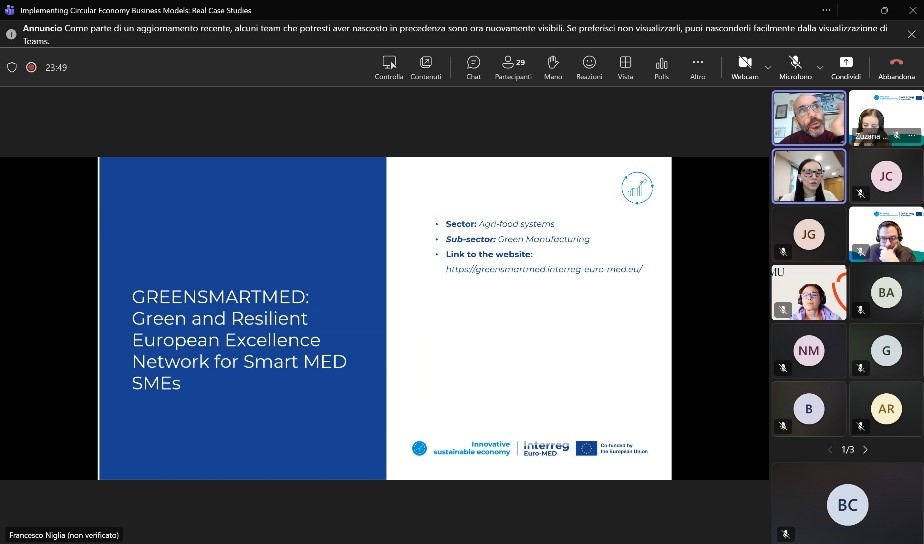 During the event, the GREENSMARTMED project was presented by CERTH and highlighted as a premier case study for driving regional and transregional cooperation. The presentation detailed the methodology, focusing on:
- RIS3 Alignment: Ensuring R&I efforts target high-potential regional sectors.
- The 4-Helix Model: De-risking innovation by involving SMEs, policymakers, BSOs, and Academia.
- Tailored Support: Moving beyond generic advice to provide specific capability assessments and identification of financial instruments for SMEs.
Spotlight on the Greek Case: Transforming Western Macedonia
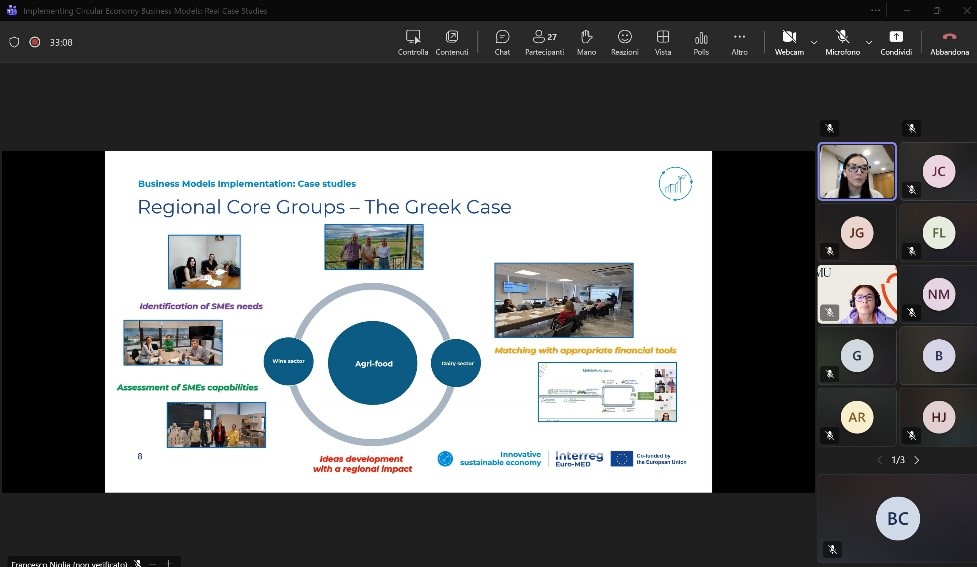 A significant portion of the presentation focused on the Regional Core Groups in Western Macedonia. CERTH presented key highlights from the Greek case centered on the agri-food sector, specifically targeting the wine and dairy industries, mobilizing 26 SMEs—comprising 14 wineries and 12 cheese factories—alongside public authorities, research institutions, and business support organizations. A key takeaway shared with the community was the outcome of these collaborations which led to concrete circular outcomes, such as the importance of establishing composting units to valorize winery biowaste and the utilization of dairy whey for the production of biogas and high-added-value by-products.
Read this article for a more in-depth look at the work of the Regional Core Group in Greece.
The session also served as a platform to share lessons learned. CERTH shared how it overcame initial skepticism from SMEs—who often perceive such projects as “too academic”—by utilizing one-to-one meetings and demonstrating immediate, practical value through capability assessments.
From Presentation to Investment: The Dedicated Factsheet
A significant outcome of our participation in this session was the receipt of a dedicated business case factsheet specifically developed for the GREENSMARTMED project. These factsheet serves as a strategic tool for our next steps, providing:
- Project Business Cases: A professional framing of our circular initiatives to match investor expectations.
- Strategic Recommendations: Key suggestions to improve the financiability and bankability of our ideas
- Roadmaps for Growth: Clear next steps and actions to bridge the gap between technical success and large-scale investment.
As we move forward to further fine-tune and transfer the methodology to other Mediterranean regions, we are turning proven circular results into competitive regional policy and ensuring a resilient, green future for SMEs across the basin.